Mehwish Fatima, Aga Khan University, writes about rethinking English language education for future healthcare professionals.
When we teach English to healthcare students, we often begin with a seemingly straightforward question: what English does this profession need?
I have taught English to nursing students and, in a different context, to dental students. At first, the answer seemed obvious. Nursing students need English for patient assessment, symptoms, medication, health education and care. Dental students need English for oral health, dental history, procedures and treatment.
But teaching across these two professional contexts made me pause.
How different are the communication needs of healthcare professionals really?
The more I observed students working with professional scenarios, the more I noticed the common ground.
A nurse might ask, “Can you describe your pain?” A dental student might ask, “Can you describe where the pain started?” A nurse may explain what will happen during a procedure. A dental professional may do exactly the same. Both may need to reassure an anxious patient, check understanding, give instructions, explain risks, document information and communicate with colleagues.
The clinical knowledge may differ. The communicative work often does not.
This observation has made me reconsider how we conceptualise English for healthcare students.
Beyond specialised vocabulary
Healthcare English is sometimes approached primarily through terminology. Vocabulary is certainly important. Students need to understand and use words such as diagnosis, inflammation, discharge, medication, infection and treatment.
But knowing terminology does not necessarily mean being able to communicate effectively.
Consider the difference between knowing the word discharge and being able to say: “Before you go home, I would like to explain how you should take your medication and when you need to return to the hospital.”
The second task involves much more than vocabulary. The student has to sequence information, select appropriate language, explain rather than simply name, adapt technical language for a patient and check whether the patient has understood.
This distinction matters.
Healthcare professionals do not simply know words. They use language to perform professional actions.
They elicit information.
They explain.
They question.
They reassure.
They clarify.
They educate.
They document.
They hand over information.
They raise concerns.
They collaborate.
This suggests that healthcare English needs to move beyond language knowledge towards language in professional action.
From “English for nurses” to “English for healthcare communication”
This does not mean abandoning English for Specific Purposes (ESP). Nursing students still need nursing English. Dental students still need dental English. Profession-specific language, genres and communicative practices remain essential.
However, my experience has led me to consider whether these profession-specific elements could sit within a broader framework of healthcare communication.
I see three interconnected layers:
Core healthcare communication
These are communicative practices shared across healthcare professions:
- asking appropriate questions
- eliciting patient information
- listening actively
- explaining procedures
- giving instructions
- showing empathy
- checking understanding
- adapting language to different audiences
- communicating sensitive information
Profession-specific communication
This is where ESP remains particularly important.
Nursing students may need to practise nursing assessment, patient education, care documentation and clinical handover.
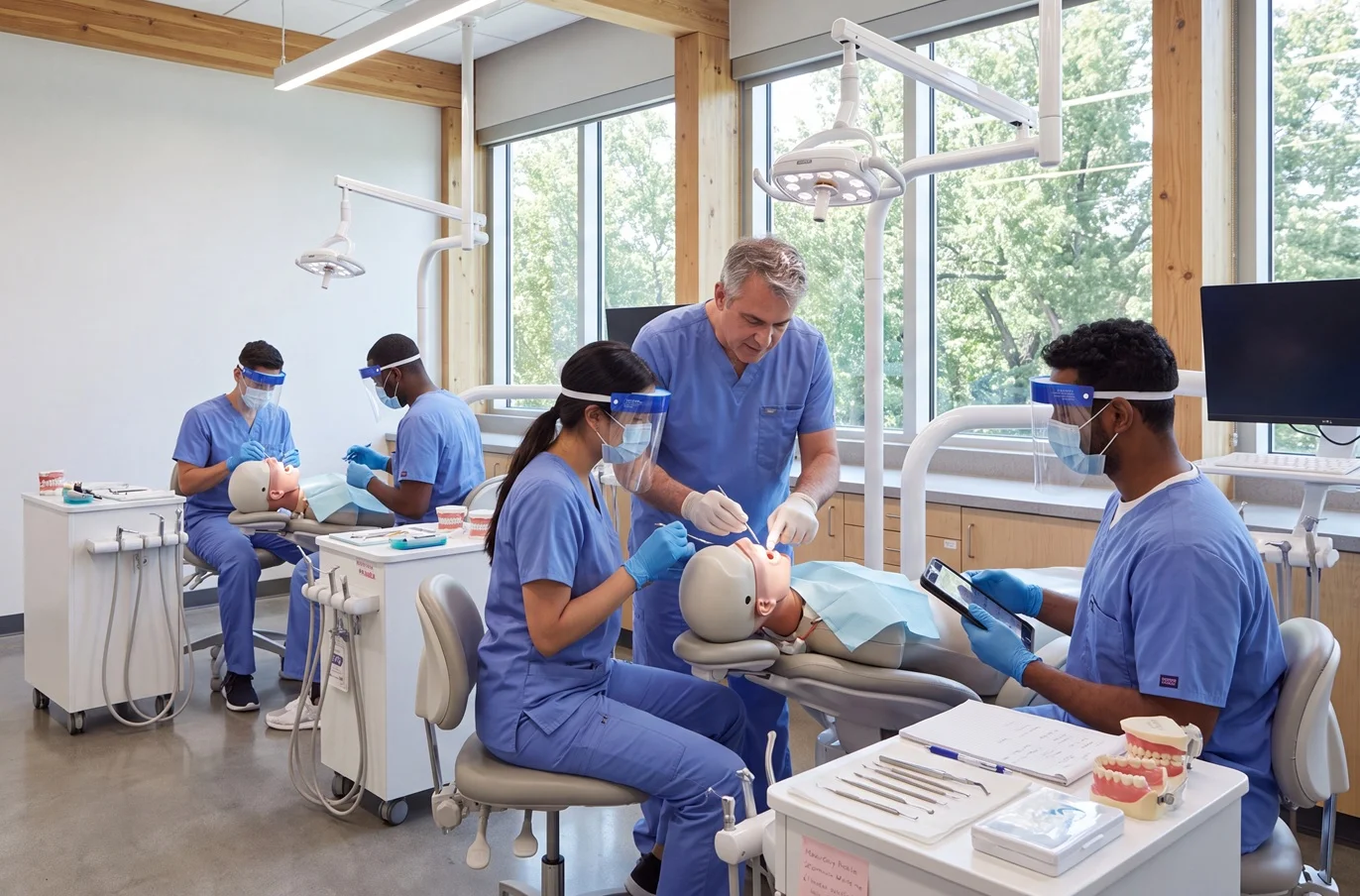
Dental students may need to practise dental history-taking, explaining treatment options, discussing oral-health practices and communicating with patients about procedures.
The language becomes increasingly specialised because the professional tasks are specialised.
Interprofessional communication
There is, however, another layer that students will encounter beyond their own professional boundaries.
Healthcare professionals need to communicate with other healthcare professionals.
A nurse may need to clarify information with a dentist. A dentist may need to communicate relevant patient information with a physician. Professionals may need to explain terminology, ask for clarification, present concerns, negotiate a plan or contribute information to a shared decision.
Here, the question is no longer simply: “Can the student communicate as a nurse or dentist?”
It becomes: “Can the student communicate as a healthcare professional who is part of a wider team?”
What might this look like in the English classroom?
One way of exploring this is to move away from teaching language as a list of isolated items and towards professional scenarios that require students to use language to solve problems.
Imagine a case involving a patient with diabetes who requires dental treatment.
Instead of asking students simply to learn vocabulary related to diabetes or dentistry, we could ask them to work through a professional communication scenario.
Students might need to:
- identify relevant information from a patient history;
- ask appropriate follow-up questions;
- explain the patient’s situation to another healthcare professional;
- clarify unfamiliar terminology;
- distinguish between technical and patient-friendly language;
- discuss the patient’s needs;
- provide an explanation that the patient can understand; and
- document relevant information.
The language classroom has now become connected to a professional task.
English is no longer something students are expected to learn before they enter professional practice.
It becomes part of how they practise.
The opportunity for collaboration
This approach also creates an opportunity to rethink the relationship between the English language educator and the healthcare educator.
The English educator does not need to become a nurse, dentist or physician. Equally, the healthcare educator does not need to become a language specialist.
Instead, each brings a different form of expertise. The healthcare educator contributes clinical knowledge, professional expectations and authentic disciplinary contexts. The English educator contributes expertise in language, discourse, communication, pedagogy and language development.
The most interesting learning opportunities may emerge between these areas of expertise.
This is where interdisciplinary or interprofessional curriculum design becomes particularly valuable. Rather than adding another isolated English activity to an already crowded healthcare curriculum, language learning can be embedded into professional scenarios that students already need to understand.
Rethinking the boundaries of ESP
My experience of teaching nursing and dental students has made me question a common assumption about ESP: that becoming more specialised necessarily means becoming more separate.
Perhaps the future of healthcare ESP is not simply about creating increasingly precise language courses for increasingly narrow professions. Perhaps it is also about identifying the shared communicative practices that connect those professions.
This is particularly relevant because healthcare education increasingly recognises the importance of interprofessional learning and collaboration. Recent systematic reviews have reported improvements in areas such as interprofessional knowledge, attitudes and collaborative outcomes, although the evidence varies in quality and researchers continue to call for stronger studies.
For language educators, this raises an interesting question: if healthcare education is preparing students to work collaboratively, should language education prepare them only to communicate within their own discipline?
From language competence to professional participation
Perhaps the shift I am proposing is a relatively small one.
We do not need to replace ESP with a generic course called Healthcare English. Instead, we could think of healthcare language education as having both specificity and connectivity.
Students need the language of their profession. But they also need the communicative resources to participate in a healthcare environment where different professions meet.
This could influence not only what we teach, but also how we design learning and assessment.
Instead of assessing whether students remember terminology, we might ask whether they can use appropriate language to perform a professional task.
Instead of designing activities around vocabulary lists, we might design them around patient scenarios, clinical conversations, handovers, explanations and collaborative problem-solving.
Instead of positioning the English classroom at the margins of professional education, we might position it as one of the spaces where students begin developing their professional communicative identities.
A question rather than a conclusion
My experience with nursing and dental students has not given me a definitive answer. It has given me a question: if healthcare itself is increasingly collaborative, should healthcare English education remain entirely discipline-specific?
Perhaps the next step for ESP is not simply to become more specialised. Perhaps it is to become more connected.
The future healthcare professional will need to know the language of their own discipline. But they will also need to cross professional boundaries: to explain, question, clarify, listen, negotiate and collaborate.
For language educators, this presents an opportunity. We can continue teaching English for a profession. But perhaps we can also begin teaching English for professional action, interaction and collaboration.
And perhaps, in doing so, the English classroom can become not just a place where future healthcare professionals learn English, but a place where they begin learning how to communicate as members of a healthcare community.
Mehwish Fatima is an Instructor at the Aga Khan School of Nursing and Midwifery, Karachi, Pakistan, where she teaches English to BSc Nursing Year 1 students. Her work focuses on integrating language instruction with nursing science to create authentic, low-anxiety learning experiences for future healthcare professionals.